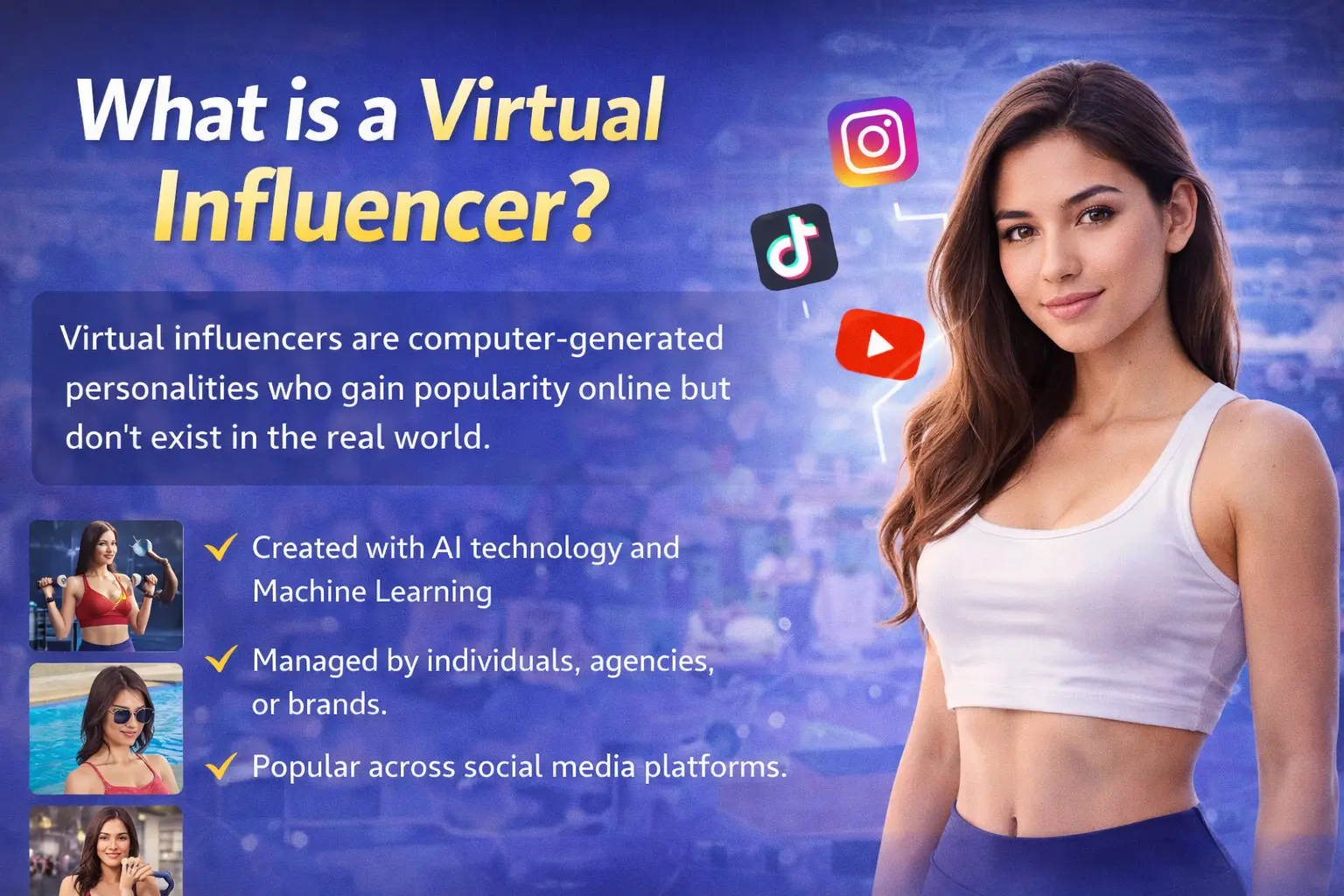
Social media has changed the way people interact with brands, celebrities, and creators. Over the past few years, a new kind of online personality has started gaining attention — the virtual influencer. If you’ve ever seen a social media profile that looks real but belongs to a computer-generated character, you may already know what a virtual influencer is. In this article, we’ll explore What is a Virtual Influencer, how they are created, how people use them, and why they have become popular today.
What is a Virtual Influencer?
A virtual influencer is a computer-generated digital personality that exists only on the internet. These characters do not have a physical identity in the real world, yet they look lifelike, share posts, interact with followers, and even collaborate with brands.
When we talk about What is a Virtual Influencer, we are referring to AI-created characters whose appearance, style, and personality are designed using artificial intelligence tools and machine learning models. Everything about them — including their expressions, lifestyle, captions, and opinions — is controlled by the creators behind them.
Some virtual influencers are managed by individuals, while others are developed by companies, media studios, or marketing agencies. They behave like real influencers, but every action they take is scripted and generated digitally.
What is a Virtual Influencer and How Are They Created?
To understand What is a Virtual Influencer, it also helps to know how they are created. Virtual influencers are designed using AI-powered graphics tools, digital modeling platforms, and creative prompts. Their look, personality, and social presence are crafted step-by-step.
Creators use tools like AI image generators, editing software, and creative prompts to build their faces, outfits, emotions, and lifestyle themes. Today, it has become easier to create AI influencers because many tools allow anyone to generate realistic images with consistency.
A virtual influencer can belong to any niche. For example, some are built around fitness, fashion, gaming, travel, technology, food, or art. The creator simply decides what type of character they want, writes prompts, and generates images that match the desired theme.
The process may look technical from the outside, but the core idea is simple — a virtual influencer is designed through imagination, storytelling, and AI technology.
What is a Virtual Influencer in the Context of AI Tools?
While exploring What is a Virtual Influencer, you may also wonder how AI tools help in the creation process. Many creators today use free and open-source software to build digital influencers.
One of the tools used for generating virtual influencer images is Fooocus, which can be run through Google Colab. It allows users to generate multiple character images while maintaining facial consistency. This means the same face can appear in different poses, locations, and expressions, making the influencer look real and active on social media.
Creators adjust prompts, choose image quality settings, control lighting, apply styles, and modify expressions. They can also add or remove elements like outfits, accessories, or backgrounds. With every new prompt, the influencer gets another realistic photo to post online.
Once the creator understands the workflow and settings, generating images becomes easier and more flexible for regular content posting.
What is a Virtual Influencer Lifestyle on Social Media?
To understand What is a Virtual Influencer, it also helps to see how they behave online. Just like real influencers, virtual influencers maintain an online persona. They post photos, share updates, work with brands, and interact with followers.
Most of them have defined characteristics such as hobbies, fashion style, mood, or profession. Some may look like models, while others represent athletes, travelers, or digital creators.
Their life is presented through carefully planned posts. Since everything is managed by the creator, each image and caption is crafted to match the influencer’s personality.
The consistent storytelling makes users feel connected, even though the influencer is artificial. Over time, these characters develop a fan base and gain the same kind of popularity as human creators.
What is a Virtual Influencer and Who Are Some Popular Examples?
While studying What is a Virtual Influencer, it is interesting to look at a few well-known virtual personalities. Some of the most recognized names include Lil Miquela, Lu Do Magalu, Shudu, and Aitana Lopez.
Lil Miquela became popular on Instagram as a fictional character from Los Angeles. She shares lifestyle content, music, and brand campaigns. Lu Do Magalu is another widely known Brazilian virtual personality who began as a digital shopping assistant and later turned into a mainstream influencer.
Shudu is known as a digital supermodel, created with a realistic and artistic appearance. Aitana Lopez represents a modern fitness-inspired AI influencer who has attracted a growing online audience.
These examples show that virtual influencers can belong to different cultures, styles, and creative identities while still appealing to real followers.
What is a Virtual Influencer Creation Challenge?
Although virtual influencers are creative and interesting, the process behind them is not always simple. When learning What is a Virtual Influencer, many creators discover challenges such as prompt accuracy, time-consuming image generation, slow rendering, or tool disconnection issues.
Sometimes, multiple attempts are required before the perfect image is produced. The creator has to carefully describe emotions, poses, and expressions to generate natural-looking content.
Another limitation is that most tools focus on images and not full-motion videos. Creating animated or cinematic content still requires traditional design and editing skills.
Even with these challenges, more people continue experimenting with virtual influencer creation because the possibilities are expanding with every new AI update.
What is a Virtual Influencer Advantage for Creators and Brands?
A major reason people are curious about What is a Virtual Influencer is because of the opportunities it creates. Virtual influencers do not need travel, studio equipment, or physical presence. Their content can be created digitally in any environment.
Creators can maintain privacy while still running a social media profile. Brands also collaborate with virtual influencers because their communication and image can be controlled precisely.
Campaigns can be modeled visually before publishing, and the influencer can represent a brand identity in a consistent and creative way.
From a creative perspective, virtual influencers allow storytelling beyond real-world limitations.
Final Thoughts on What is a Virtual Influencer
The concept of What is a Virtual Influencer and AI Art Generators represents a new shift in digital creativity. These characters may not exist physically, but their impact on social media culture is real. They are designed with imagination, technology, and storytelling — and they show how digital identities are evolving in the modern online world.
As AI tools continue to improve, virtual influencers will likely become even more detailed, expressive, and creative. Whether you see them as characters, marketing tools, or artistic experiments, they are an interesting part of today’s digital landscape.